
Article updated as of November 2025
Click to listen to a NotebookLM AI overview of this article:
Paralegals are pushing Supio to its full potential - and then some.
We’ve spent months observing how they use legal AI - what they ask, how they think, and where they rely on AI for personal injury cases most.
Supio power users get source-linked detailed answers across the entire case lifecycle, from early discovery through litigation. And they use the insights they get to drive strategy.
TLDR: How Paralegals Are Using AI in Personal Injury Law
- Early case intelligence: AI legal tools spot missed diagnoses, treatment gaps, and inconsistencies during discovery—leading to stronger settlements.
- Precision case economics: AI calculates exact recoverable damages after reductions and liens, eliminating guesswork and giving attorneys confidence in negotiations.
- Unified case narrative: One AI-powered chronology (expert-reviewed) becomes the foundation for all legal documents, reducing drafting time up to 70%.
These 7 takeaways come directly from high performer paralegals like Amber Fernatt (J. Chrisp Law) and Kelly Osborne (Childers, Schlueter & Smith).
Here’s what they’re doing right and why it works.
What we found is a new way of working. And it starts with the people who know the case best.
1. They use AI for early case discovery—not just pre-trial prep
The top paralegals look for problems early before they become problems.
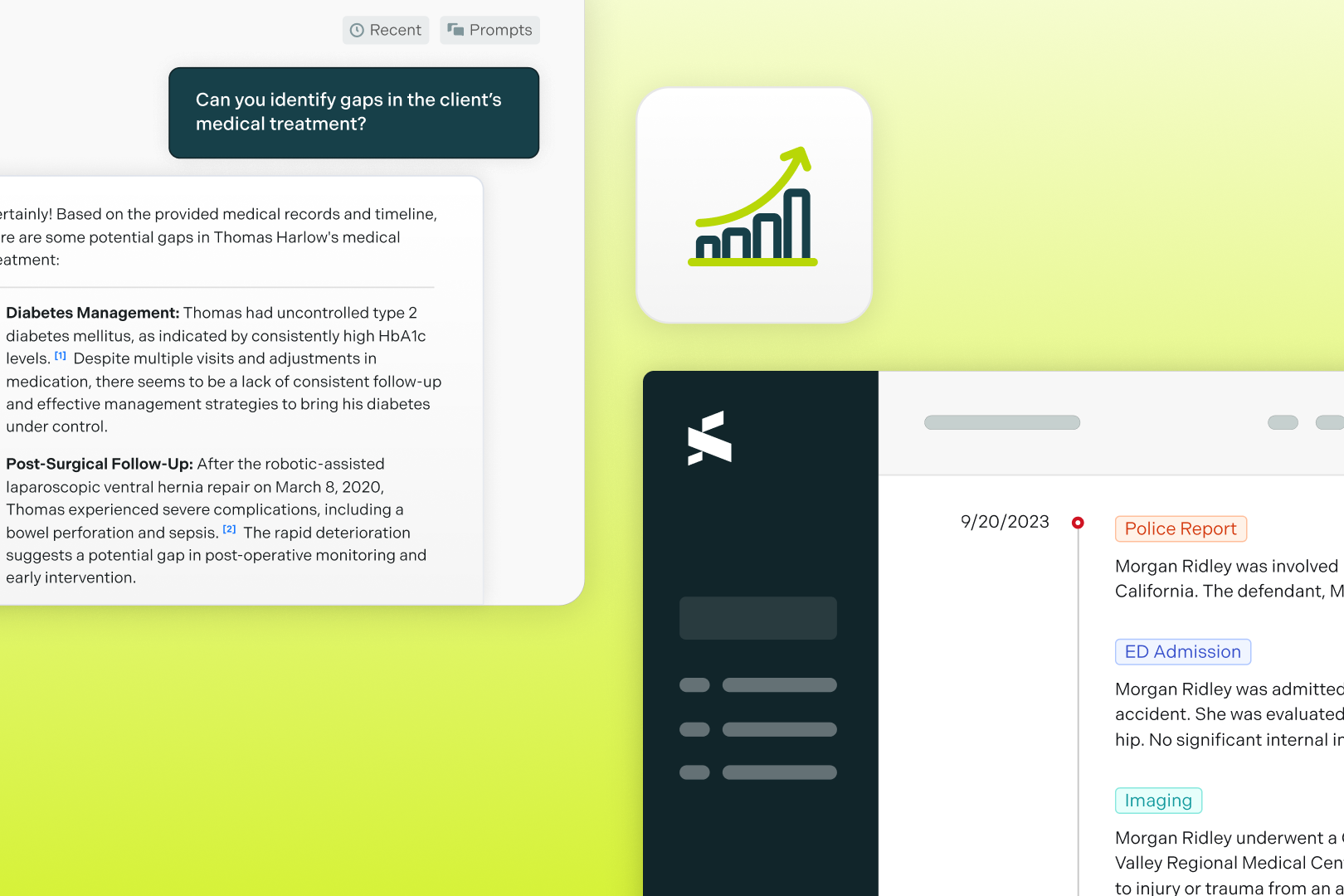
AI legal research tools help them do that by unlocking the full story fast. With the AI Assistant, they can chat directly against medical records, bills and liens, provider timelines, even deposition transcripts - all in one place.
That means they’re spotting missed diagnoses, gaps in treatment, and inconsistencies months sooner than before.
This kind of early clarity leads to stronger cases - more accurate settlement demands, tighter case theory, and better client outcomes.
Leading paralegals use legal AI software to identify case issues during discovery rather than waiting until problems surface in depositions or mediation.
2. They use conversational prompts with AI legal tools (no technical jargon required)
Kelly doesn’t overthink her prompts. She just talks to Supio like she would a trusted medical expert or attorney.
- “What happened with the left knee?”
- “Has the client had an MRI?”
These aren’t prompts, they’re questions. Supio is built to respond like someone who knows the file inside and out.
This conversational approach to AI in legal practice works because it mirrors how paralegals already think through cases. No technical jargon required.
3. They iterate with AI instead of crafting "perfect prompts"
There’s no secret language. Kelly reminds new users to just ask your question and build from there.
Prompting is a learning curve, and it gets easier with muscle memory. Supio responds best when you keep iterating just like you would with a real teammate.
What works: Start with simple, direct questions. Refine based on the response. Build complexity as you go.
What doesn't work: Spending 10 minutes crafting the "perfect" initial prompt before getting started.
4. They automate legal document review so they can focus on clients
Kelly describes her role as a balancing act: part trauma-informed counselor, part protocol-driven operator. It’s emotionally heavy work that also demands precision - every date, every document, every detail.
Supio helps her manage both.
By offloading the mechanical tasks (scanning records, checking treatment criteria, organizing timelines) AI tools for law firms give her something that’s rare in personal injury law: the time and headspace to actually be there for clients.
That’s not a small thing. Many of the cases Supio supports involve grief, loss, or life-changing injuries. The professionals doing this work need room to be human.
The shift: AI handles data extraction and organization. Paralegals focus on client communication, strategy, and the human elements that actually move cases forward.
5. They calculate precise case economics with AI, not rough estimates
Paralegals using Supio aren’t working off ballpark figures anymore. They’re calculating exact recoverable value down to the dollar.
That means knowing the difference between what was billed and what’s actually compensable after reductions, write-offs, and state-specific rules.
This changes the entire tone of mediation. Instead of vague projections, clients see exactly what they’ll walk away with - after fees, costs, and liens. Everything’s modeled in real time.
When attorneys walk into negotiations, the certainty they bring shuts down gamesmanship from insurance adjusters.
Why it matters: Precision in case economics builds client trust and eliminates last-minute surprises that can derail settlements.
6. They build one AI-powered case narrative that drives all legal documents
With Supio, paralegals are building a fully connected case narrative where every motion, disclosure, and demand ties back to the same foundation.
Want to pull records for a specific provider?
Prep an expert disclosure?
Brainstorm case strategies and themes?
It all starts from the same, synced source: the Supio-powered chronology.
And here’s the secret sauce: behind every Supio-powered chronology is a layer of human review. Real legal professionals check and refine the case documentation to ensure your data is as dialed in and litigation-ready as possible. It’s this blend of AI + expert oversight that makes the case story stronger, cleaner, and easier to build on.
7. They're building AI proficiency now while competitors fall behind
As Amber puts it, there’s real urgency to get fluent with these tools now. The teams adopting AI with intention are already pulling ahead.
The competitive gap isn't about who has access to AI legal tools—it's about who's using them effectively.
Firms that integrate AI into their workflows strategically see:
- Faster case progression from intake to settlement
- More accurate damage calculations and case valuations
- Earlier identification of case weaknesses and strengths
- Better client communication backed by data
Hear it straight from expert PI paralegals
Watch our recorded session with top paralegals Amber Fernatt and Kelly Osborne as they demonstrate how they use AI for personal injury cases to drive strategy, clarity, and results. Get their real-world tips and workflows on demand.
Ready to see how leading personal injury firms are implementing AI? Explore our resources on AI for personal injury lawyers and schedule a consultation to discuss your firm's AI strategy.