Register for our live webinar

6 Things Your Personal Injury Practice Should Be Doing With AI

In this webinar, we’ll break down the six essential ways every PI practice should be leveraging AI today to increase efficiency, strengthen outcomes, and scale intelligently — without adding headcount.
Artificial intelligence is no longer a future concept for personal injury firms — it’s a competitive advantage available right now.

As caseloads grow and medical documentation becomes more complex, firms relying on manual review and generic tools risk leaving time, efficiency, and case value on the table. Purpose-built AI for personal injury law is changing how leading firms evaluate cases, uncover damages, prepare demands, and walk into litigation fully prepared.

In this webinar, we’ll break down the six essential ways every PI practice should be leveraging AI today to increase efficiency, strengthen outcomes, and scale intelligently — without adding headcount.

What You’ll Learn:

1. Strengthen Intake & Early Case Evaluation
Use AI to rapidly analyze new matters, identify viable claims, flag liability issues, and surface treatment gaps early — ensuring your team focuses on the highest-value opportunities from day one.

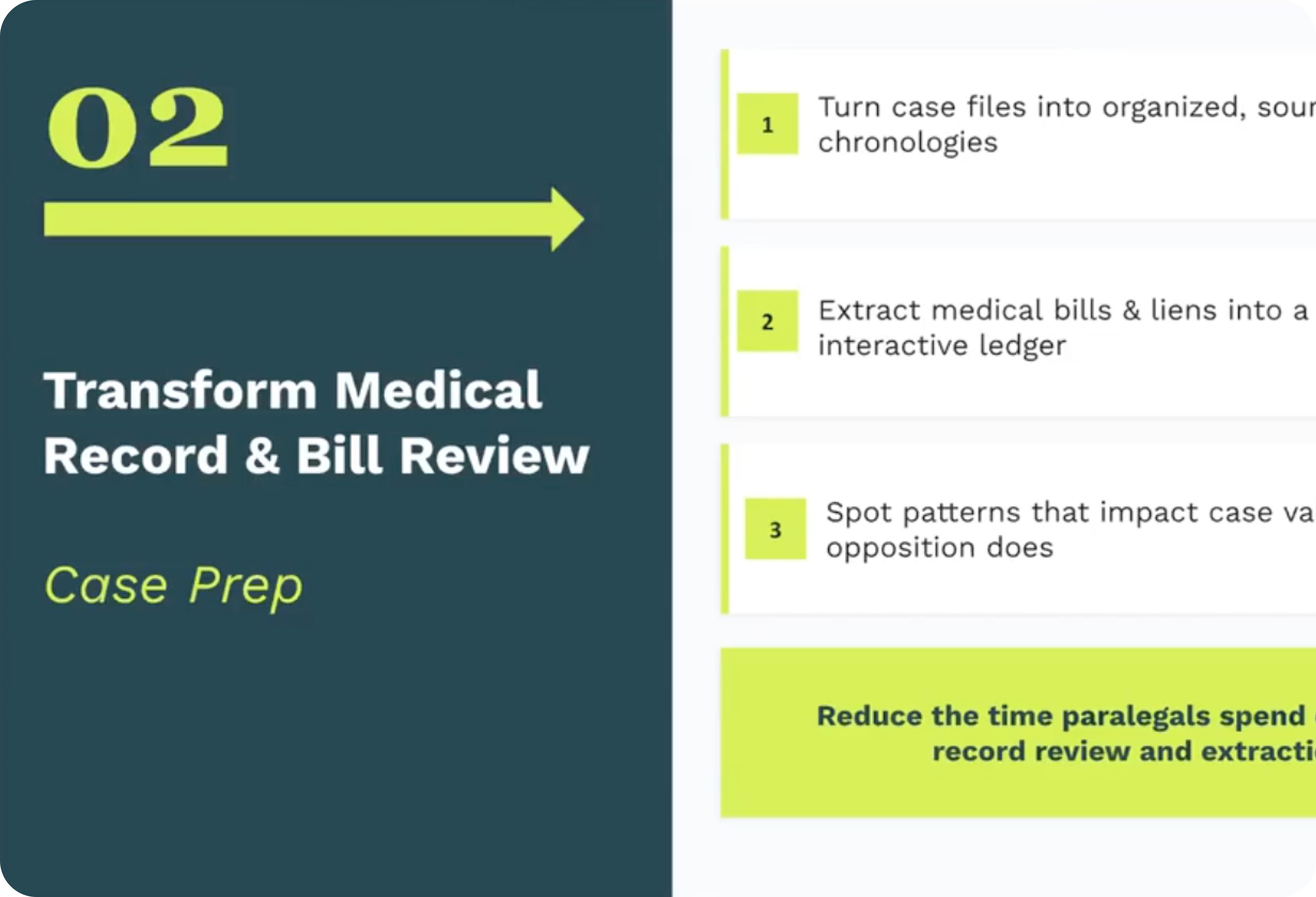
2. Transform Medical Record Review
Turn thousands of pages of medical records into organized, source-linked chronologies in minutes. AI can identify injuries, prior history, inconsistencies, and billing patterns that impact case value.

3. Draft Demands & Litigation Documents Faster
Leverage AI to generate settlement demands, complaints, and key litigation documents aligned with your firm’s voice — reducing drafting time while maintaining quality and consistency.

4. Uncover Hidden Case Value
Connect treatment timelines, billing data, and injury documentation to reveal overlooked damages and strategic leverage points that strengthen negotiation positions.

5. Scale Without Increasing Overhead
Support attorneys, paralegals, and case managers with AI-driven workflows that allow your firm to handle more cases — efficiently and compliantly — without proportional increases in staffing.

6. Elevate Litigation & Trial Preparation
Prepare smarter for depositions, mediation, and trial. Use AI to surface inconsistencies, generate deposition outlines, summarize expert reports, and instantly retrieve source-backed facts — helping your team build stronger narratives and reduce surprises in court.

Who Should Attend:
Managing partners, trial attorneys, and operations leaders at personal injury firms looking for practical, real-world applications of AI that drive measurable results.

Join us on March 17 at 10:00 a.m. to learn how AI can move from buzzword to competitive advantage inside your personal injury practice.

About the webinar

Artificial intelligence is no longer a future concept for personal injury firms — it’s a competitive advantage available right now.

As caseloads grow and medical documentation becomes more complex, firms relying on manual review and generic tools risk leaving time, efficiency, and case value on the table. Purpose-built AI for personal injury law is changing how leading firms evaluate cases, uncover damages, prepare demands, and walk into litigation fully prepared.

In this webinar, we’ll break down the six essential ways every PI practice should be leveraging AI today to increase efficiency, strengthen outcomes, and scale intelligently — without adding headcount.

What You’ll Learn:

1. Strengthen Intake & Early Case Evaluation
Use AI to rapidly analyze new matters, identify viable claims, flag liability issues, and surface treatment gaps early — ensuring your team focuses on the highest-value opportunities from day one.

2. Transform Medical Record Review
Turn thousands of pages of medical records into organized, source-linked chronologies in minutes. AI can identify injuries, prior history, inconsistencies, and billing patterns that impact case value.

3. Draft Demands & Litigation Documents Faster
Leverage AI to generate settlement demands, complaints, and key litigation documents aligned with your firm’s voice — reducing drafting time while maintaining quality and consistency.

4. Uncover Hidden Case Value
Connect treatment timelines, billing data, and injury documentation to reveal overlooked damages and strategic leverage points that strengthen negotiation positions.

5. Scale Without Increasing Overhead
Support attorneys, paralegals, and case managers with AI-driven workflows that allow your firm to handle more cases — efficiently and compliantly — without proportional increases in staffing.

6. Elevate Litigation & Trial Preparation
Prepare smarter for depositions, mediation, and trial. Use AI to surface inconsistencies, generate deposition outlines, summarize expert reports, and instantly retrieve source-backed facts — helping your team build stronger narratives and reduce surprises in court.

Who Should Attend:
Managing partners, trial attorneys, and operations leaders at personal injury firms looking for practical, real-world applications of AI that drive measurable results.

Join us on March 17 at 10:00 a.m. to learn how AI can move from buzzword to competitive advantage inside your personal injury practice.

Panel

Kevin Mould
Supio

Register to watch

About the webinar

Artificial intelligence is no longer a future concept for personal injury firms — it’s a competitive advantage available right now.

As caseloads grow and medical documentation becomes more complex, firms relying on manual review and generic tools risk leaving time, efficiency, and case value on the table. Purpose-built AI for personal injury law is changing how leading firms evaluate cases, uncover damages, prepare demands, and walk into litigation fully prepared.

In this webinar, we’ll break down the six essential ways every PI practice should be leveraging AI today to increase efficiency, strengthen outcomes, and scale intelligently — without adding headcount.

What You’ll Learn:

1. Strengthen Intake & Early Case Evaluation
Use AI to rapidly analyze new matters, identify viable claims, flag liability issues, and surface treatment gaps early — ensuring your team focuses on the highest-value opportunities from day one.

2. Transform Medical Record Review
Turn thousands of pages of medical records into organized, source-linked chronologies in minutes. AI can identify injuries, prior history, inconsistencies, and billing patterns that impact case value.

3. Draft Demands & Litigation Documents Faster
Leverage AI to generate settlement demands, complaints, and key litigation documents aligned with your firm’s voice — reducing drafting time while maintaining quality and consistency.

4. Uncover Hidden Case Value
Connect treatment timelines, billing data, and injury documentation to reveal overlooked damages and strategic leverage points that strengthen negotiation positions.

5. Scale Without Increasing Overhead
Support attorneys, paralegals, and case managers with AI-driven workflows that allow your firm to handle more cases — efficiently and compliantly — without proportional increases in staffing.

6. Elevate Litigation & Trial Preparation
Prepare smarter for depositions, mediation, and trial. Use AI to surface inconsistencies, generate deposition outlines, summarize expert reports, and instantly retrieve source-backed facts — helping your team build stronger narratives and reduce surprises in court.

Who Should Attend:
Managing partners, trial attorneys, and operations leaders at personal injury firms looking for practical, real-world applications of AI that drive measurable results.

Join us on March 17 at 10:00 a.m. to learn how AI can move from buzzword to competitive advantage inside your personal injury practice.

Panel

Kevin Mould
Supio

Register to watch

Watch the Replay

Panel

Kevin Mould
Supio

About the webinar

Artificial intelligence is no longer a future concept for personal injury firms — it’s a competitive advantage available right now.

As caseloads grow and medical documentation becomes more complex, firms relying on manual review and generic tools risk leaving time, efficiency, and case value on the table. Purpose-built AI for personal injury law is changing how leading firms evaluate cases, uncover damages, prepare demands, and walk into litigation fully prepared.

In this webinar, we’ll break down the six essential ways every PI practice should be leveraging AI today to increase efficiency, strengthen outcomes, and scale intelligently — without adding headcount.

What You’ll Learn:

1. Strengthen Intake & Early Case Evaluation
Use AI to rapidly analyze new matters, identify viable claims, flag liability issues, and surface treatment gaps early — ensuring your team focuses on the highest-value opportunities from day one.

2. Transform Medical Record Review
Turn thousands of pages of medical records into organized, source-linked chronologies in minutes. AI can identify injuries, prior history, inconsistencies, and billing patterns that impact case value.

3. Draft Demands & Litigation Documents Faster
Leverage AI to generate settlement demands, complaints, and key litigation documents aligned with your firm’s voice — reducing drafting time while maintaining quality and consistency.

4. Uncover Hidden Case Value
Connect treatment timelines, billing data, and injury documentation to reveal overlooked damages and strategic leverage points that strengthen negotiation positions.

5. Scale Without Increasing Overhead
Support attorneys, paralegals, and case managers with AI-driven workflows that allow your firm to handle more cases — efficiently and compliantly — without proportional increases in staffing.

6. Elevate Litigation & Trial Preparation
Prepare smarter for depositions, mediation, and trial. Use AI to surface inconsistencies, generate deposition outlines, summarize expert reports, and instantly retrieve source-backed facts — helping your team build stronger narratives and reduce surprises in court.

Who Should Attend:
Managing partners, trial attorneys, and operations leaders at personal injury firms looking for practical, real-world applications of AI that drive measurable results.

Join us on March 17 at 10:00 a.m. to learn how AI can move from buzzword to competitive advantage inside your personal injury practice.

See Supio in Action

Book a demo to see all the ways Supio can help your firm maximize settlements and take on more cases.