

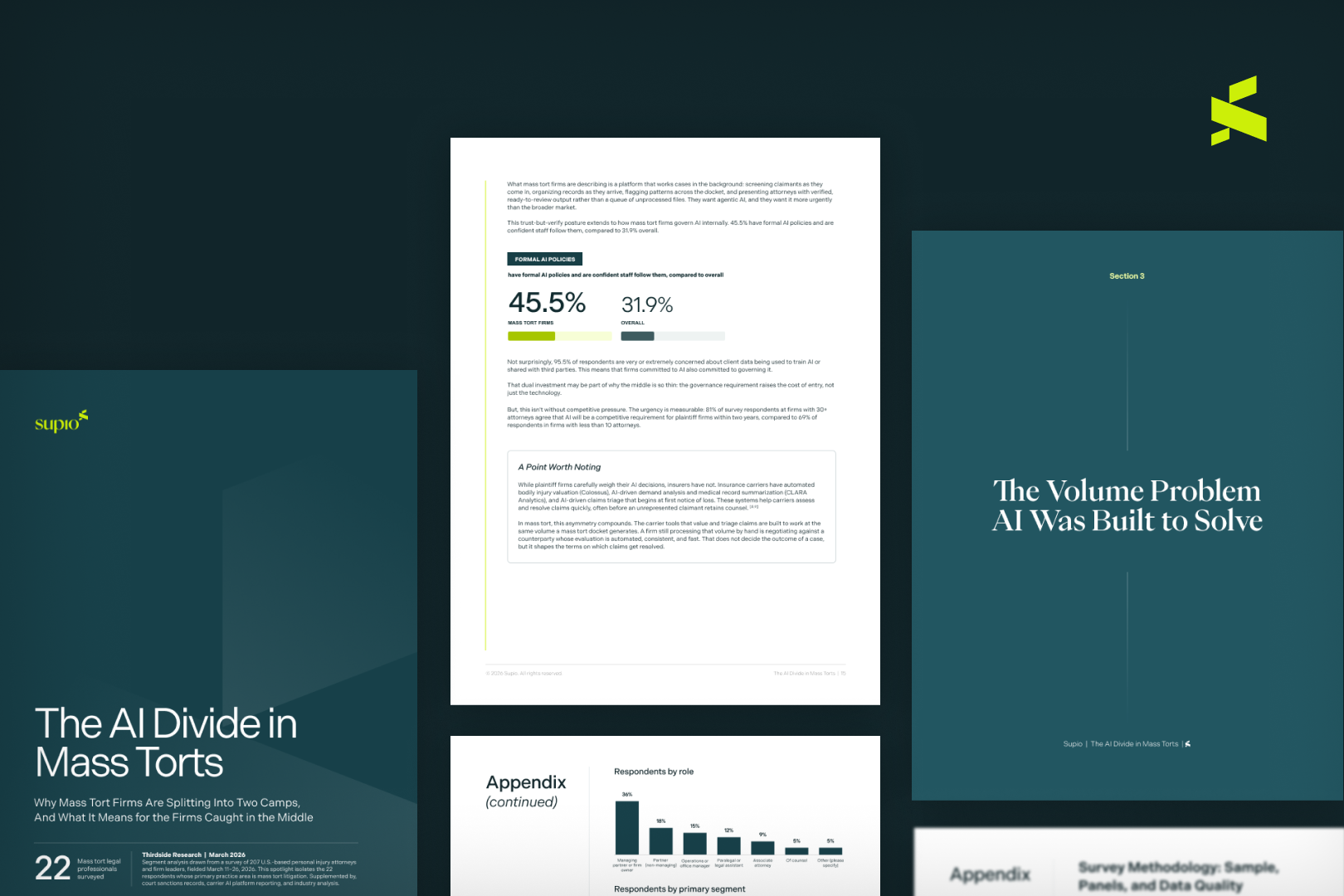
Ask the average plaintiff firm about AI and you'll get a range of answers: trying it, testing it, thinking about it. Ask a mass tort firm the same question and you'll usually get one of two answers. Yes, or no.
That's the central finding in Supio's newest spotlight report, The AI Divide in Mass Torts, a companion to The State of AI in Plaintiff Law 2026. Drawing on the mass tort segment of a 207-attorney Thirdside Research survey, the data shows a practice area that isn't slowly warming to AI. It's splitting in two.
Nearly half of mass tort firms, 46%, now use AI regularly. That's 15 points above the broader PI market. At the same time, 32% have no plans to adopt it at all, 10 points above market. The middle ground, firms experimenting or evaluating their options, has mostly disappeared. Only 23% of mass tort firms sit there, compared to 48% of PI firms overall.
If you're a firm still deciding, the window to decide slowly just got a lot smaller.
Why mass tort doesn't follow the usual pattern
In personal injury generally, AI use is concentrated in pre-litigation work: intake, demand letters, the assembly work done before a case reaches litigation. Adoption on the litigation side is much lower, sitting around a quarter of firms.
Mass tort looks different. 54.5% of mass tort litigation attorneys use AI today, more than double the overall market rate. That tracks with what mass tort litigation actually involves: comparing claimants to build settlement tiers, synthesizing evidence across an entire docket, spotting patterns that a single case would never surface. That kind of work happens at the litigation stage, not before it.
The task breakdown supports this. Among mass tort firms using AI, adoption is higher than the broader market in intake and screening (up 18.5 points) and client communication (up 18.3 points), while legal research and citation work, which leads AI use in the broader PI market at 44.3%, trails the market by nearly 23 points. Mass tort firms aren't primarily using AI to draft faster. They're using it to move more claimants through the pipeline without letting quality slip.
The bottleneck isn't a document or case. It's the docket.
The broader PI report frames the capacity problem around a single artifact, the demand letter. Mass tort doesn't have one bottleneck like that. As of July 2026 there were more than 200,000 pending actions across active MDL dockets, with the top five the largest spanning tens of thousands of claimants each. The real constraint sits upstream of any single filing: screening, causation development, and documentation that will hold up across an entire claimant population.
That pressure is compounding with capital. Litigation finance has grown into a $16.1 billion industry, and mass tort firms increasingly operate with third-party funding attached, funding that comes with an expectation that weak claims get filtered out early rather than found late.
Firms trust the output but don't want a human required at every step
Here's where the report's findings get more interesting. Like the broader PI market, mass tort firms are strict about verification. Every single respondent, 100%, said they won't use AI content they can't verify, an even higher bar than the 99% seen market-wide. That makes sense given the stakes: a misread diagnosis in a Plaintiff Fact Sheet can end a claim outright, and the same kind of error can impact an entire claimant population.
But mass tort firms are noticeably more comfortable letting AI work without a person checking every single step. 31.8% are comfortable with that kind of autonomy on routine tasks, compared to 20.8% overall, and only 36.4% insist on review at every stage, versus 45.9% market-wide. In practice, that means firms want the option to check any output at any time, without needing to sign off on every output before work continues. In fact, 53.8% of mass tort respondents ranked ongoing, unprompted case processing as the single most important capability, well above the 33.9% who said the same across all of PI.
Verify anything, anytime. Just don't require verification of everything, every time.
What this means if you're still deciding
The report's conclusion is straightforward: what works in mass tort looks different from what works in general PI. The firms pulling ahead are the ones running continuous case processing, built around docket-wide value rather than any single document, fully traceable, and operating inside governed, closed systems. On that last point, 95.5% of respondents are highly concerned about client data being used to train outside models, and firms that have committed to AI have generally committed to policy around it too. 45.5% now have formal AI governance and confidence that staff actually follow it, compared to 31.9% overall.
The competitive timeline is real too. 81% of attorneys at firms with 30 or more lawyers expect AI to become a competitive requirement within two years. And the report's scale model suggests the gap compounds rather than levels off: as claimant volume grows, mass tort firms already using AI see cost per claimant fall, while firms still working by hand see bottlenecks and error rates climb.
The AI adoption gap for mass tort firms isn't just thin. It's closing.
{{cta="/blog-components/mass-tort-report-component"}}