

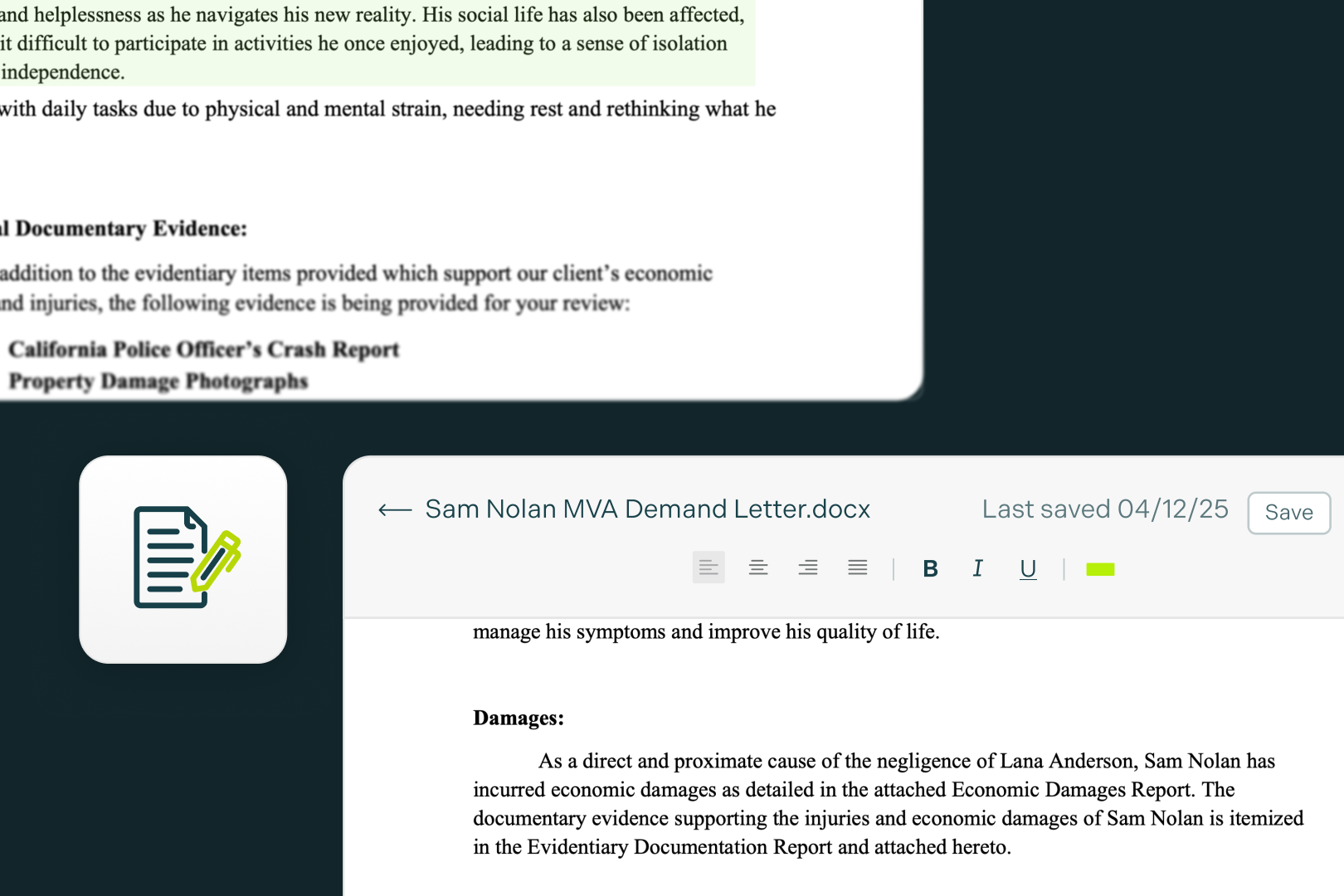
Choosing the right legal AI platform to assist with demand letter automation can mean the difference between pushing policy limits and leaving money on the table.
Not all legal AI is built the same. While manual demand drafting takes 3-8 hours per case, the right automation tool cuts this to minutes—but only if you know which features actually matter for settlement outcomes.
TL;DR:
- Purpose-built AI trained on personal injury data outperforms generic chatbots by understanding medical terminology, ICD codes, and case-specific strategies
- Verifiable accuracy with linked citations (96%+ extraction accuracy, 97%+ citation precision) ensures every claim is defensible and traceable to source documents
- Human verification of economic calculations ensures bill accuracy when hitting policy limits
- Unlimited editing, seamless integration, and enterprise security eliminate hidden costs while protecting sensitive client data and fitting existing workflows
- Advanced platforms capture your unique tone, style, and brand identity
Quick Answer: What are the must-have features in a demand letter automation tool?
The most critical features include purpose-built AI trained specifically on personal injury data (not generic language models), verifiable accuracy with every claim linking to source documents, the ability to distinguish facts from opinions in medical records, unlimited editing without per-revision fees, seamless integration with your case management system, and enterprise-grade security (SOC 2, HIPAA, GDPR compliance). Equally important: platforms that capture your firm's distinctive voice and brand, deliver complete exhibits packages alongside narrative drafts, and combine AI efficiency with human verification of economic calculations to ensure billing accuracy when pursuing policy limits. Platforms with these capabilities typically achieve 96%+ extraction accuracy and help firms reduce demand drafting time from 3-8 hours to minutes while improving settlement outcomes.
Why the Right Features Determine Your Settlement Outcomes
Leveraging AI for demand letter drafting can reduce preparation time from 3-8 hours down to minutes—but choosing the wrong tool can cost your clients tens of thousands in undervalued settlements.
According to Thomson Reuters, attorneys spend an average of 3.2 hours drafting demand letters from scratch. The 2025 Legal Industry Report shows 37% of personal injury lawyers already use generative AI for document drafting—and that percentage is climbing rapidly. However, the firms achieving the best results aren't using generic tools; they're deploying platforms purpose-built for personal injury workflows.
The difference matters. A poorly constructed demand can undervalue your case significantly, while a compelling, data-backed demand pushes policy limits and accelerates settlements. But speed alone isn't enough—there's an inherent tension between generating fast first drafts and delivering the complete, polished package that actually wins settlements. The distinction often comes down to these core features.
Purpose-Built AI vs. Generic Language Models
The most critical distinction separates general-purpose language models from purpose-built legal AI trained specifically on personal injury case data.
Generic AI chatbots like ChatGPT generate text quickly but lack nuanced understanding of medical terminology, ICD codes, causation arguments, and settlement strategies. These tools produce generic prose that clearly reads like algorithm-generated content. Worse, they can't capture your firm's distinctive tone and approach—everything sounds the same.
Purpose-built legal AI for PI understands the unique structure of personal injury cases. It recognizes the difference between evidence (police reports, medical records) and opinions (provider notes), extracts key facts across multiple data modalities, and applies case-type-specific analysis.
Technical Metrics That Matter
When evaluating platforms, ask vendors for specific benchmarks:
- Extraction accuracy: Leading platforms achieve 96%+ accuracy identifying and extracting relevant facts
- Citation precision: Best-in-class tools maintain 97%+ citation precision with every claim linking to source documents
- Case type coverage: Robust platforms support 100+ distinct case types with tailored analysis
- Multi-modal processing: Systems should understand medical records, bills, and voice transcripts at the very least
- Economic calculation accuracy: Ask specifically about how the platform handles medical bill summation and verification—particularly critical when targeting policy limits
As Eric Chaffin, Founder and Managing Partner at Chaffin Luhana LLP, describes: "It's like taking Einstein and multiplying it multiple times. The most strategic thinkers can't learn as quickly as it's learning."
Distinguishing Facts from Opinions in Medical Records
One of the most sophisticated capabilities in advanced platforms is the ability to distinguish facts from opinions throughout case documents.
Medical records mix objective findings (diagnostic tests, imaging results) with subjective interpretations (provider opinions, patient-reported symptoms). Effective demands emphasize verifiable facts while appropriately contextualizing opinions.
Case-aware AI separates:
- Evidence: Police reports, diagnostic imaging, lab results, billing records
- Opinions: Provider clinical notes, therapy progress notes, preliminary assessments
This creates a "safe to interrogate" environment where every claim is traceable to its source, preventing the common pitfall of presenting opinions as established facts—which undermines credibility with adjusters and defense counsel.
Customization, Editing, and Firm-Specific Branding
A demand letter reflects your firm's brand and approach. The best automation tools balance efficiency with personalization while capturing the distinctive voice that makes your firm stand out.
Essential Customization Capabilities
Look for platforms that enable you to:
- Tailor tone and style through intuitive interfaces that learn your firm's unique voice
- Save custom templates based on successful past demands
- Make unlimited edits without additional costs per revision
- Maintain firm branding across all outputs
- Train the AI on your historical demands to replicate your preferred phrasing and argumentation style
You should be able to refine demands through conversational interactions—prompting the AI to "emphasize my client's pain and suffering" or "incorporate details from the life impact report"—with instant responses that maintain factual accuracy. Whether your approach is aggressive and trial-focused or collaborative and settlement-oriented, the platform should adapt to match your established style—not force generic, algorithm-sounding language into your demands.
Critical consideration: Avoid platforms charging per revision or requiring external provider submissions for edits. This creates delays and unpredictable costs.
Seamless Integration with Case Management Systems
Demand letter automation delivers maximum value when it works within your existing workflow rather than creating additional administrative burden.
Integration Essentials
Evaluate whether platforms offer:
- Native integrations with major systems (Filevine, Litify, Salesforce, CasePeer)
- Automatic data syncing with bi-directional information flow
- Document management compatibility (Dropbox, OneDrive, SharePoint)
- API access for custom connections
Without proper integration, you'll waste time manually uploading documents and reconciling inconsistencies. Seamless integration means documents flow automatically and insights sync back to your case management system.
Verification, Accuracy, and the "Human in the Loop" Advantage
Even the most advanced AI requires human oversight—but the level of verification varies significantly across platforms.
Quality Assurance Mechanisms
The most reliable platforms incorporate:
- Linked source citations: Every statement links to supporting documents
- Automated consistency checks: AI flags contradictions or missing information
- Expert review options: Access to legal professionals for complex or high-value cases
- ICD code verification: Automatic injury mapping with treatment record validation
- Economic verification: Human review of medical bill calculations and damage totals to ensure accuracy when pursuing policy limits
This human-in-the-loop verification becomes especially critical with economic calculations. While AI excels at drafting compelling narrative prose, accurately summing medical bills, calculating lost wages, and projecting future care costs requires meticulous attention to detail. A single miscalculation can leave tens of thousands of dollars on the table or undermine your credibility with adjusters—particularly problematic when you're trying to hit policy limits. The best platforms combine AI's efficiency with human verification of the economics, ensuring that every dollar of medical expenses, lost wages, and future damages is accurately documented and defensible.
Gwen Marie Davis, Owner of GDH Law, shares: "Policy limits came out"—demonstrating how accurate, well-structured demands maximize settlement values.
Enterprise-Grade Security and Compliance
Demand letters contain highly sensitive client information. Your platform must meet rigorous security standards.
Essential Security Requirements
Verify that platforms provide:
- SOC 2 Type II certification with independent security validation
- HIPAA compliance for protected health information
- GDPR compliance for appropriate data privacy protections
- End-to-end encryption for data in transit and at rest
- US-based data centers (or appropriate jurisdictions)
- Continuous 24/7 monitoring and comprehensive audit trails
According to the American Bar Association, 29% of law firms experienced security breaches in 2024. Enterprise-grade security isn't optional—it's a professional responsibility.
Speed Without Sacrificing Quality
While manual drafting consumes 3-8 hours per case, purpose-built AI platforms generate comprehensive first drafts in minutes. But efficiency gains extend beyond initial generation:
- Instant chronology generation with ICD codes
- Automated damage calculations across economic losses
- Pre-built exhibit compilation and formatting
- Integrated review workflows for collaboration
However, speed creates an inherent tension with quality that separates good platforms from great ones. Fast first drafts are valuable, but they mean little if they arrive incomplete—missing crucial elements like a fully assembled exhibits package, curated photos that tell your client's story, or properly formatted supporting documentation. Many AI tools can generate narrative prose quickly but leave you scrambling to compile exhibits, organize medical records, and format attachments manually. The best vendors don't force you to choose between speed and completeness. They deliver both: a polished, compelling narrative draft and a comprehensive, submission-ready exhibits package in the same timeframe. This completeness is what actually accelerates settlements, not just fast text generation.
The Federal Bar Association reports firms leveraging legal AI for routine document drafting see productivity increases of 25-40% across paralegal teams.
Automation vs. Outsourcing: A Strategic Comparison
{{automation-comparison="/blog-components/demand-letter-automation-features"}}
For firms handling 10+ demands monthly, automation typically delivers superior ROI while maintaining tighter quality control.
Red Flags to Watch For
Be cautious if vendors:
- Can't provide specific accuracy metrics beyond vague "AI-powered" claims
- Lack transparent pricing with hidden per-revision fees
- Don't offer integration options requiring duplicate data entry
- Show no legal-specific training (generic AI repurposed for legal work)
- Have no human verification option for high-stakes demands or economic calculations
- Can't demonstrate success stories with specific settlement improvements
- Deliver narrative drafts without complete exhibits packages
- Can't adapt to your firm's distinctive tone and brand voice
Trust but verify: request demonstration cases using your firm's real (anonymized) data.
Key Questions Answered
What's the difference between general AI and purpose-built legal AI?
General AI lacks specialized training on medical records, legal precedents, and personal injury case structures. Purpose-built legal AI understands ICD codes, distinguishes facts from opinions, and applies case-type-specific analysis. It also learns your firm's unique voice and approach, ensuring outputs reinforce rather than dilute your brand. The output quality difference is substantial—purpose-built platforms generate demands that read like they were written by experienced paralegals from your own team.
How do I verify accuracy?
Look for platforms providing extraction accuracy above 96%, citation precision above 97%, and support for 100+ case types. Every claim should link directly to source documents. Pay special attention to how the platform handles economic calculations—ask whether human reviewers verify medical bill totals and damage calculations, particularly for cases approaching policy limits. The best tools offer optional human expert review as additional quality assurance.
Can AI handle complex, high-value cases?
Yes, but sophistication varies across platforms. Purpose-built legal AI handles complex cases with multiple injuries and extensive treatment timelines. However, for high-value cases where economic accuracy is critical—particularly when pursuing policy limits—look for platforms that combine AI efficiency with human verification of bill summation and damage calculations. For exceptionally high-value cases (potential settlements exceeding $500K-1M), consider platforms offering optional human expert review combining AI efficiency with legal expertise.
Making the Right Choice
The right demand letter automation platform should understand personal injury cases the way experienced paralegals do, distinguish facts from opinions, integrate seamlessly with existing systems, provide verifiable accuracy, offer unlimited customization, meet enterprise-grade security standards, and support rapid iteration without hidden fees. Beyond these fundamentals, the best platforms capture and replicate your firm's distinctive tone and brand, deliver complete exhibits packages alongside narrative drafts (not just fast text), and combine AI's efficiency with human verification of economic calculations—ensuring billing accuracy when every dollar counts toward hitting policy limits.
As Tom D'Amore, Owner of D'Amore Law, observes: "Supio picks up things we might miss"—highlighting how purpose-built legal AI identifies opportunities that even experienced attorneys might overlook in complex cases.
The firms achieving the best results aren't using generic AI chatbots. They're deploying sophisticated platforms purpose-built for personal injury workflows, trained on legal data, calibrated to their firm's unique voice, and augmented with human expertise when stakes are highest—particularly for verifying the economic accuracy that determines whether you hit policy limits or leave money on the table.
Ready to see how purpose-built demand letter automation can transform your practice? Schedule a demo to experience AI that understands personal injury cases the way your team does—and delivers demand packages that push policy limits and accelerate settlements.