
Putting AI to Work in Mass Torts: Trust, Adoption, and What’s Next
Supio and TorHoerman Law unpack new survey data showing mass tort firms are split on AI adoption, and what verifiable, defensible AI-assisted work looks like at MDL scale.
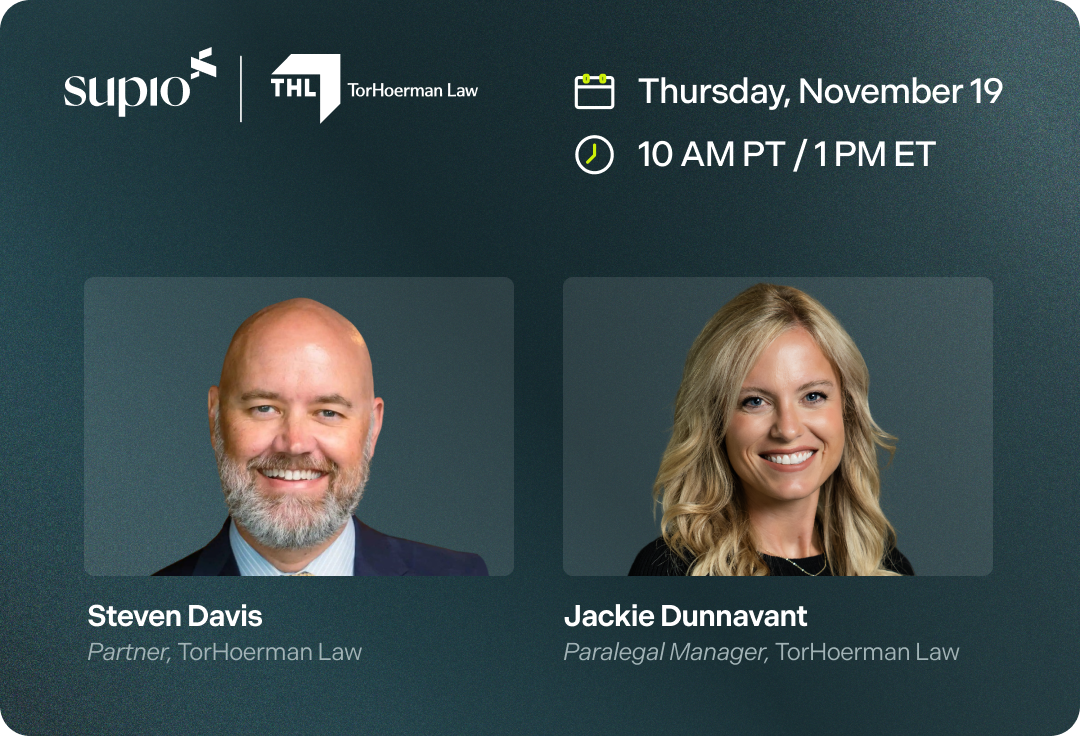
Thursday, November 19 | 10 AM PT
Page-by-page review no longer works at mass tort scale. With records in the tens of thousands, firms are splitting over whether and how to bring in AI. In Supio’s 2026 survey of 207 U.S. personal injury attorneys and firm leaders, conducted by Thirdside Research, 45.5% of the 22 mass tort respondents use AI regularly. 31.8% have no plans. Only 22.7% are still experimenting or evaluating.
This session breaks down the divide at MDL scale: where mass tort AI use differs from the rest of PI, why firms want AI that works without being asked, and why every output has to be verifiable. We close with TorHoerman Law, an early Supio customer whose use has grown to include Supio Agent, to show what it looks like in practice.
What you’ll walk away with:
- Where the market stands. Mass tort adoption has polarized. Only 22.7% of mass tort respondents are experimenting or evaluating, compared with 47.8% of all 207 respondents. We’ll cover what that means for firms still weighing their options.
- Where AI actually gets used. Among the 14 mass tort respondents whose firms use AI, more use it for client communication (42.9% vs. 24.6% overall). Fewer use it for legal research and citation (21.4% vs. 44.3%). In mass torts, AI is doing high-volume pipeline work, not the research and drafting cycle that leads in the rest of PI.
- What “trust but verify” means at docket scale and what defensible AI-assisted work looks like. All 22 mass tort respondents said they won’t use AI content unless they can verify its sources. Yet only 36.4% insist on human review at every step (vs. 45.9% overall). Our take: every output should be traceable to its source, but not every output needs sign-off before work moves forward. Source traceability and documented, attorney-directed review are what make AI-assisted work defensible. That matters when one misread treatment date in a Plaintiff Fact Sheet can end a claim.
- How TorHoerman Law’s work has changed. Steven Davis and Jackie Dunnavant share how and why the firm brought AI into its mass tort practice and how its use has grown. They’ll cover how their attorney and paralegal workflows have changed, the efficiencies their teams have seen, how they’ve used Supio in recent wins and settlements, and where they see room for AI to grow next.
Panel


Save your spot
See Supio In Action
Book a demo to see all the ways Supio can help your firm maximize settlements and take on more cases.