

Article updated September 2026.
By harnessing an AI agent built for plaintiff law, attorneys can work every claimant in their inventory, ground every argument in authoritative law, and build the evidence-ready files that win when verdicts land.
Mass tort litigation has always been a contest of scale. A single firm may carry thousands of claimants across multiple MDLs – each with its own medical record, its own causation, criteria, and its own place in a bellwether or settlement timeline. The volume that makes these cases valuable is the same volume that makes them hard to work. And the firms that win are the ones that can see, organize, and act on all of it.
That challenge has only intensified. As of early 2026, the federal multidistrict litigation system carries roughly 160 active dockets and nearly 198,000 pending actions, with about 95% of all case volume concentrated in the 25 largest dockets, according to data from the Judicial Panel on Multidistrict Litigation. Trial dates, Daubert deadlines, and settlement frameworks are converging across multiple dockets at once – and the category itself is expanding beyond drugs and devices into tech-driven torts like social media addiction, ride-share assault, and app-based gambling. The firms positioned to move when verdicts come in are the ones with complete, evidence-ready files built before bellwether results set the value floor.
This is where an agent changes the equation. Supio Agent – the first end-to-end agentic AI platform built exclusively for plaintiff law – doesn't just summarize what you hand it. It works your cases the way a practitioner does: planning, researching, drafting, and acting across every case in your docket, with your attorneys in control.
From Document Review to an Agent That Works the Case
Earlier generations of legal AI asked you to do the setup: pick the files, upload them, prompt the tool, and read back a summary. Supio Agent removes that friction entirely. Connected directly to your case management system and records through integrations, the agent navigates the matter on its own – no file selection, no manual uploads. You point it at the question; it goes and finds what it needs.
That shift matters most in mass tort, where no one has the hours to hand-curate documents across hundreds or even thousands of clients. The agent treats your records as a single, navigable body of evidence, not a pile of files waiting to be sorted.
Find the Needle in the Haystack, Across Thousands of Pages
Defense teams know that volume can be a weapon: bury the one relevant fact under thousands of pages and hope it never surfaces. Supio Agent neutralizes that tactic. It reads the full record – medical records, expert reports, depositions – and surfaces what matters in minutes.
Because the agent is multi-threaded, it can deploy sub-agents that work like specialists assigned to a single issue, searching in parallel until they find what you're looking for. As one customer described it, the defendant can no longer hide the needle in the haystack by dumping data on you.
For a firm running a mass tort inventory, that can mean turning hundreds of pages of clinical records like nursing notes, monitor strips, and vital sign charts, into a clean, minute-by-minute timeline, then saving that work as a reusable skill so the next claimant's file is ready in a fraction of the time.
Research Grounded in Authoritative Law
In mass tort, your legal theory has to hold up against the best-resourced opponents in the country – and a fabricated or misapplied citation is worse than no AI at all.
Supio Agent is the only AI platform for plaintiff law connected to Thomson Reuters Westlaw Advantage, the same authoritative research content judges rely on. When the agent needs to analyze a defense motion, test a causation argument, or prepare for a Daubert challenge, Westlaw is present step by step – not a separate tool to break away to. The agent can run Westlaw research and it validates citations on both sides, flagging the ones, including the opposition's, that don't hold up.
Intelligence Across Your Whole Docket
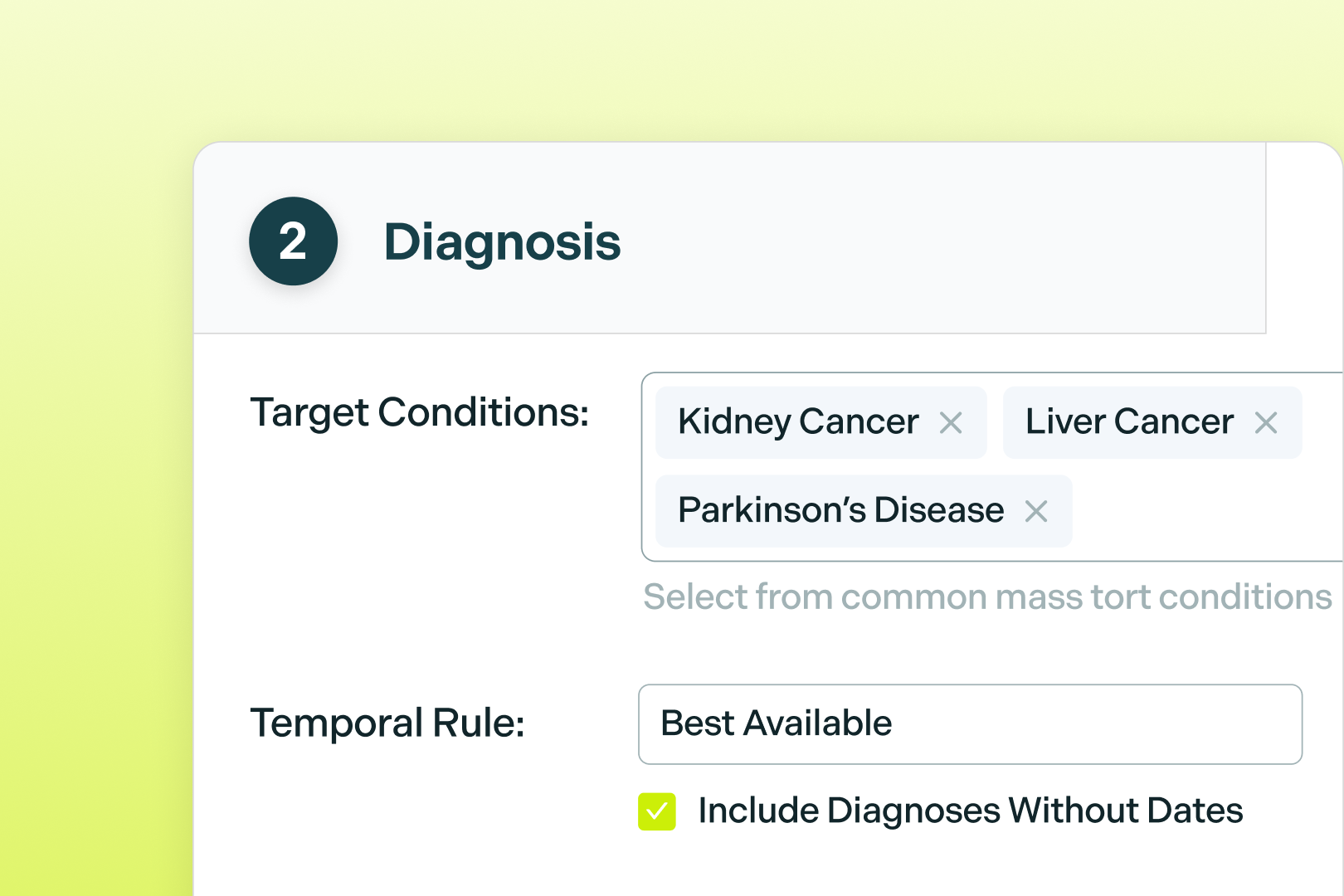
Mass tort is a portfolio, not a stack of individual files. Supio Agent operates at the docket level as well as the case level: which clients are evidence-ready, where records are missing, how matters compare against your firm's own settlement history, and which cases deserve investment ahead of a bellwether.
And the more your firm uses it, the more it learns – your templates, your strategies, your standards – applying that institutional knowledge to every new case. Context compounds. The work you put in on the first case makes the 1,000th case faster.
Accuracy You Can Defend
Trust is earned through transparency, not claims. Every Supio output traces back to its source – attorneys can click any fact to the exact document or authority behind it. The agent shows its reasoning as it works, so you can see how it reached a conclusion, not just what it concluded. It is substantiation-driven by design: it looks for evidence, not for the answer it thinks you want to hear. And it runs inside a closed, HIPAA-compliant system, so client data never touches a public model.
The result is output that is fast, authoritative, verifiable, and defensible – the standard mass tort work requires.
Built for the Way Mass Tort Really Works
The volume isn't going away – it's growing. But volume stops being a challenge when you have an agent that can read every page, ground every argument in real law, and carry what your firm knows from one case to the next. That's how plaintiff firms turn the scale of mass tort into an advantage.
See what Supio Agent can do with your docket. Book a demo.