

Industry‑specific AI is gaining traction in high‑stakes legal work, such as personal injury litigation.
{{blog-highlights="/blog-components/highlights-from-the-2026-ai-in-professional-services-report"}}
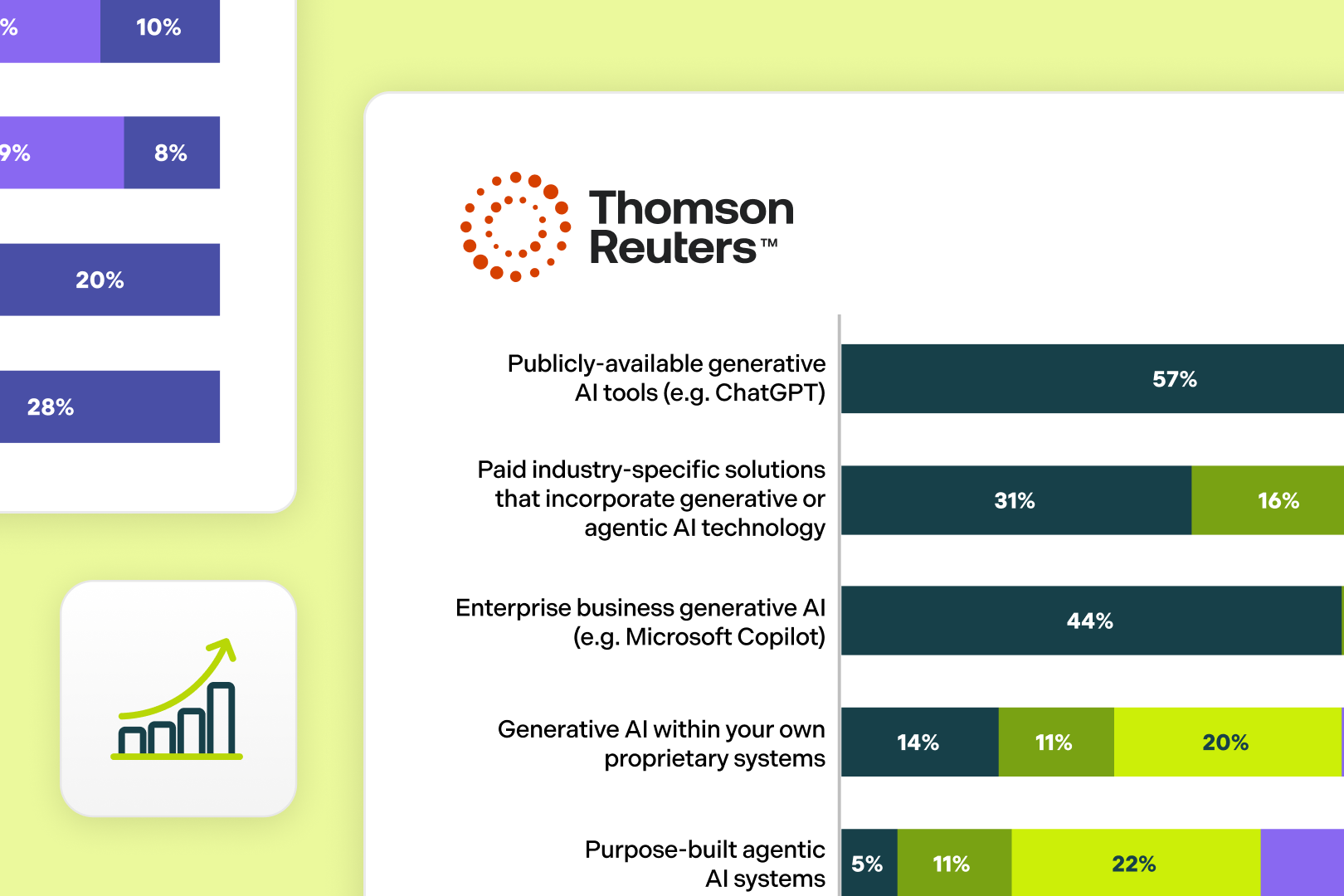
Artificial intelligence (AI) is no longer a future concept for professional services. It’s a present‑day reality. The Thomson Reuters Institute’s 2026 AI in Professional Services Report shows that organizations nearly doubled their use of generative AI in the past year, with more than half of professionals relying on publicly available tools. Industry‑specific and enterprise solutions are also gaining traction as adoption accelerates.
As AI becomes embedded in daily work, firms have moved past the question of whether to use it and toward defining what they expect it to deliver. The focus is now on outcomes that support long‑term business strategy, strengthen client relationships, and create measurable impact beyond efficiency alone. Looking ahead, 77% of professionals expect agentic AI to become central to their workflows by 2030, prompting organizations to explore early use cases.
In legal services, this evolution raises new questions about value, scale, and competitiveness. As one respondent noted, firms cannot keep up with modern‑day corporate demands without changing how legal work is executed.
From AI adoption to business impact: What the data reveals
The report highlights how quickly AI has been normalized across professional services. More than 80% of organizations report using generative AI weekly, and most professionals believe it will become central to their workflow within the next five years.
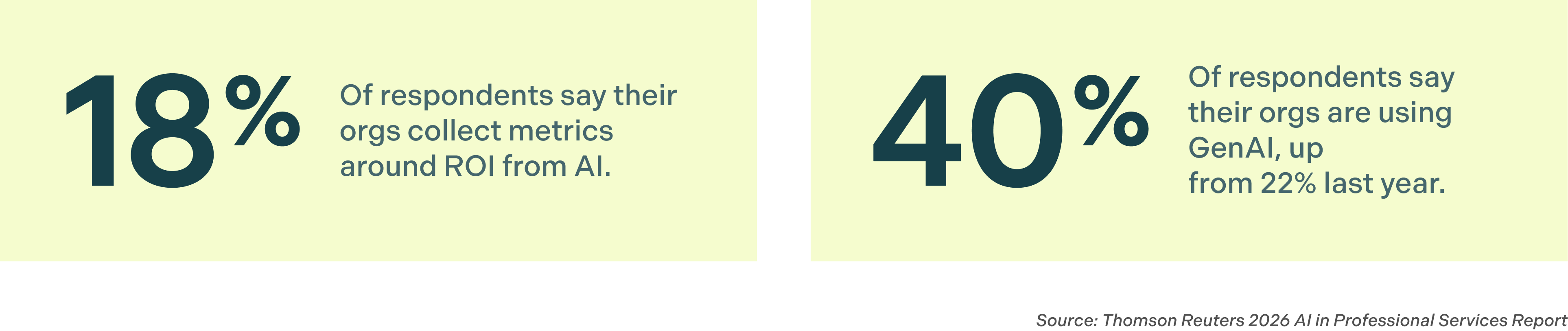
With AI adoption now widespread, organizations are moving past the question of whether AI works and toward a more complex challenge: defining what success actually looks like. Only 18% measure AI return on investment (ROI), and about 40% of respondents are unsure of whether these metrics are tracked at all. Among those that do measure impact, the focus is typically on internal metrics such as cost savings and employee usage, rather than client satisfaction or revenue impact.
For legal teams, this means connecting AI usage to outcomes such as stronger case preparation, improved client experience, and sustainable growth. Additionally, it means maintaining transparency, human oversight, and trust. In the report’s words, the winners will be those who figure out how AI elevates strategic and analytical thinking, not just speed.
Legal teams are under pressure to move faster without sacrificing trust
Legal work has always required precision, context, and judgment. Today, legal teams also face growing caseloads, tighter timelines, evolving client expectations, and increased competition.
While AI is already embedded in everyday legal tasks, teams continue to draw clear boundaries around its use. The report finds that only 17% of legal professionals feel ethically comfortable allowing AI to give legal advice, underscoring why human judgment and review remain essential even as teams push for speed.
Corporate legal teams are still weighing how far advanced automation can extend. While 48% support applying agentic AI to their work, 35% remain unsure, reflecting ongoing concerns about governance and responsibility. Together, these dynamics raise questions about how firms can accelerate work without sacrificing quality, confidence, or consistency.
Where industry-specific AI makes a difference

One of the most important trends highlighted in the report is the rise of professional-grade and industry-specific AI tools. Usage of these tools rose 14 percentage points in 2026, and many professionals say they are planning or considering them next.
Unlike general-purpose AI, these solutions are designed to operate in regulated, high-stakes environments where accuracy and trust are paramount. This distinction is especially important in personal injury litigation, where cases involve large volumes of documents and medical records.
The report also makes clear that professionals expect strong human oversight, especially as organizations explore agentic AI. That priority is shaping which tools gain traction. Partnerships like Thomson Reuters and Supio reflect how industry-specific AI is becoming integrated into specialized areas of legal practice.
A real-world example: AI applied to personal injury litigation
Personal injury (PI) litigation requires more than generic AI tools. Firms must interpret complex medical records and turn those facts into legally defensible work product, often under intense time pressure. General-purpose AI falls short because it lacks the required privacy compliance, such as HIPAA. Legal work also demands a level of precision, contextual understanding, and rigorous validation at every step.
By combining Thomson Reuters trusted legal content and AI-powered workflows in CoCounsel Legal with Supio’s specialization in personal injury case intelligence, firms gain AI purpose‑built for real‑world PI litigation.
Supio builds the factual foundation by structuring medical records, bills, and case files into clear chronologies, case ledgers, damages narratives, and draft work product. CoCounsel then pressure tests and strengthens that work against authoritative legal research, jurisdiction-specific standards, and established precedent.
Together, these technologies help firms:
- Transform complex medical records and case files into structured, case-ready intelligence
- Support research, drafting, and validation with authoritative legal content and citations
- Scale consistently across growing caseloads without adding headcount
- Improve clarity and responsiveness in client communications
Rather than replacing legal judgment, this approach connects facts, strategy, and confidence through a continuous workflow. Attorneys retain control over decisions and advocacy, while AI reduces manual effort, surfaces critical details earlier, and supports stronger, more defensible outcomes.
What comes next for AI in legal services
The data is clear. For law firms, the window for being an AI early adopter has closed. The next differentiator will be execution. That includes how effectively legal teams integrate AI into everyday workflows, align it with firm strategy, and clearly articulate its value to clients.
The report shows clients increasingly expect their outside counsel to use AI, yet fewer than 20% are mandating it through guidelines or requests for proposals (RFPs). That gap creates a critical opportunity for firms to lead the conversation, demonstrate confidence in their approach, and set expectations around how AI enhances both quality and outcomes.
To explore the full data, trends, and insights shaping this shift across legal and other professional services, download the 2026 AI in Professional Services Report from the Thomson Reuters Institute.
Want to see how this approach works in practice?
Explore how Thomson Reuters and Supio are using AI to improve personal injury case outcomes and support smarter, more scalable litigation workflows.
{{cta="/blog-components/highlights-from-the-2026-ai-in-professional-services-report"}}