

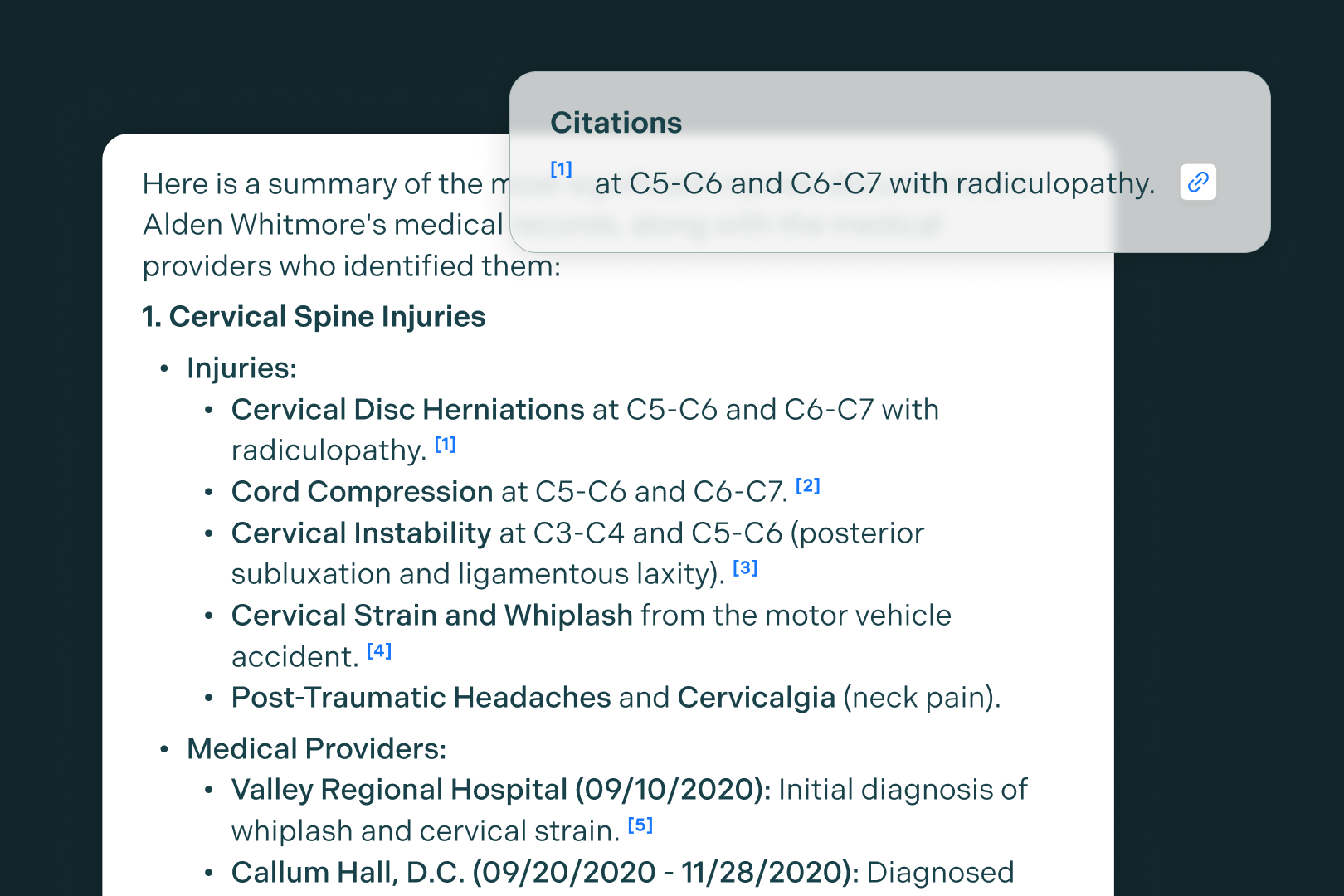
99% of attorneys say they will not use AI content they cannot verify. That single number reframes the whole AI conversation in plaintiff law. What holds attorneys back is not cost, nor complexity. It is trust, and specifically the inability to check what the AI produced.
The consensus is close to total:
- 99% won't use AI content they cannot verify
- 96% are very or extremely concerned about untraceable AI output
- 79% reject fully autonomous AI and want human review of every output
These are not the numbers of a profession that is skeptical of AI in principle. They are the numbers of a profession that is professionally constrained from relying on output it cannot stand behind.
That constraint is worth taking seriously, because it is not a preference. An attorney who signs a filing is personally accountable for what it says. The duty of candor to the court, the duty of competence to the client, and the fiduciary weight attorneys have always carried do not soften because a machine produced the first draft. When 79% say they want a human reviewing every output, they are not being timid about technology. They are applying the same standard they apply to a junior associate's work, and any tool that expects to be used in legal work has to meet it.
The caution is well-founded
Attorneys have watched what happens when unverified AI output reaches a filing. Court sanctions for AI-generated hallucinations have climbed from $5,000 in 2023 to $59,500 by late 2025. In several documented cases, the errors passed through associate and supervisor review without being caught. The problem was not carelessness. It was AI output that looked correct but could not be traced back to a source.
Wanting to verify is not the same as being able to verify
Here is the bind. The most widely used tool for plaintiff work is general-purpose AI, at 54% adoption, and it produces confident output with no source attribution. There is no way to trace a summary back to the record it came from, and no way to catch a missed date or a misread diagnosis without reading the underlying document yourself.
So the attorney who wants to verify is left doing it by hand, against a document that gives no starting point. As long as verification falls entirely on the attorney, the time savings that justified using AI get eaten by the review needed to trust it.
This is the quiet reason so many firms stall out after a promising trial. The AI looks impressive in a demo, and it genuinely produces usable text in seconds. Then the firm tries to fold it into real casework, discovers that every output still has to be checked line by line against the source, and the math stops working. The tool did not fail because it was inaccurate. It failed because it gave no way to confirm when it was accurate, which in legal work amounts to the same thing. That is why the adoption gap and the trust gap turn out to be the same gap. Firms are not waiting for AI that is more capable. They are waiting for AI they can check.
How we measured attorney trust in AI
Supio partnered with Thirdside Research to survey 207 U.S. personal-injury attorneys and firm leaders on what they need from AI and what is keeping them from committing to it. We fielded the survey between March 11 and 26, 2026, and grounded the findings in outside sources, including Stanford RegLab research, the Charlotin AI Hallucinations Cases Database, court sanctions records, and carrier AI platform documentation.
What it takes to close the trust gap
Trust is not a marketing problem to talk your way around. It is a design requirement. The 2026 State of AI in Plaintiff Law report covers the verification problem in depth, what changes when AI output can be traced to its source, and what insurance carriers are already doing with AI on the other side of the table while plaintiff firms weigh their options.
Source: Supio, 2026 State of AI in Plaintiff Law: The AI Adoption Gap. Survey of 207 U.S. personal-injury legal professionals conducted by Thirdside Research, March 2026, supplemented by Stanford RegLab research, the Charlotin AI Hallucinations Cases Database, court sanctions records, and carrier AI platform documentation.